Karen R. Dobkins, Ph.D., UC San Diego, Assistant Professor of Psychology
 

Research Interests:
         Our primary research goal is to understand visual perception in terms of underlying neural mechanisms, with an emphasis on development and plasticity of visual perception.  As a means of exploring the link between neural function and visual perception, we focus particularly on visual motion and color processing, since much is known about their neural basis.
 

Current Projects:

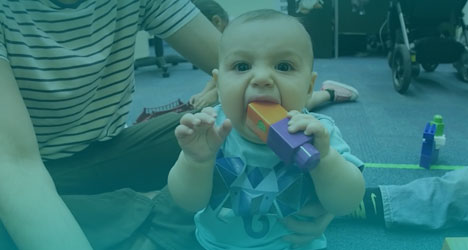
         Development of Visual Perception.  This line of study involves conducting visual psychophysical experiments in both infants and adults, in order to understand how the developing perceptual system changes with time and experience, and how underlying neural mechanisms can account for the changes.  In particular, we focus on the development of motion processing, which we investigate using behavioral techniques specially designed for infants (e.g., ìForced-Choice Preferential Lookingî and ìDirectional Eye Movement Assessmentî).  The results from our studies demonstrate that infants as young as 3 months of age possess motion processing capacities comparable to those of adults, suggesting that visual areas underlying motion perception develop rather quickly.
         In addition, we investigate the extent to which infants use information about color to see things move.  In adults, a wealth of psychophysical data has demonstrated that motion perception is impoverished when stimuli are defined solely by color. Surprisingly, the results from our infant work suggest that infants do not exhibit such a loss of motion sensitivity for color-defined stimuli, a result that has implications for the development of segregated color/motion processing streams in the primate visual system.

         Visual Plasticity from Altered Early Sensory Experience: Deaf Studies. These psychophysical studies are aimed at understanding the ways in which visual perception is altered through specific sensory experience.  In particular, we study visual processing in deaf individuals, who experience altered sensory input (i.e., auditory deprivation) and have acquired a visual language (i.e., American Sign Language).  The goal of this research is to determine what aspects of visual processing may be enhanced in the deaf, and to understand these perceptual changes within an ecological context.  Preliminary evidence from experiments employing moving dot arrays suggests that deaf people discriminate direction of motion better for right visual field targets compared to left targets, while the opposite pattern is found for hearing subjects.  In accordance with previous speculations (Neville & Lawson, 1987), this finding suggests that sensory functions required for the comprehension of a language (e.g., visual motion, in the case of Sign Language) may be ìcapturedî by the language (left) hemisphere of the brain.

         Visual Neurophysiology in Monkeys.  Another ongoing line of research includes neurophysiological experiments in awake behaving monkeys, conducted at the Salk Institute in collaboration with Dr. Thomas Albright. These studies involve recording responses of single neurons in a region of monkey visual cortex, area MT, known to be a key component of the neural substrate for motion perception. Specifically, these experiments are aimed at understanding how motion-sensitive cortical neurons utilize information about object features to signal direction of motion.  In particular, we have found a unique influence of object color on directional responses of MT neurons, challenging the widely held belief that color and motion are processed in entirely separate neural processing streams.